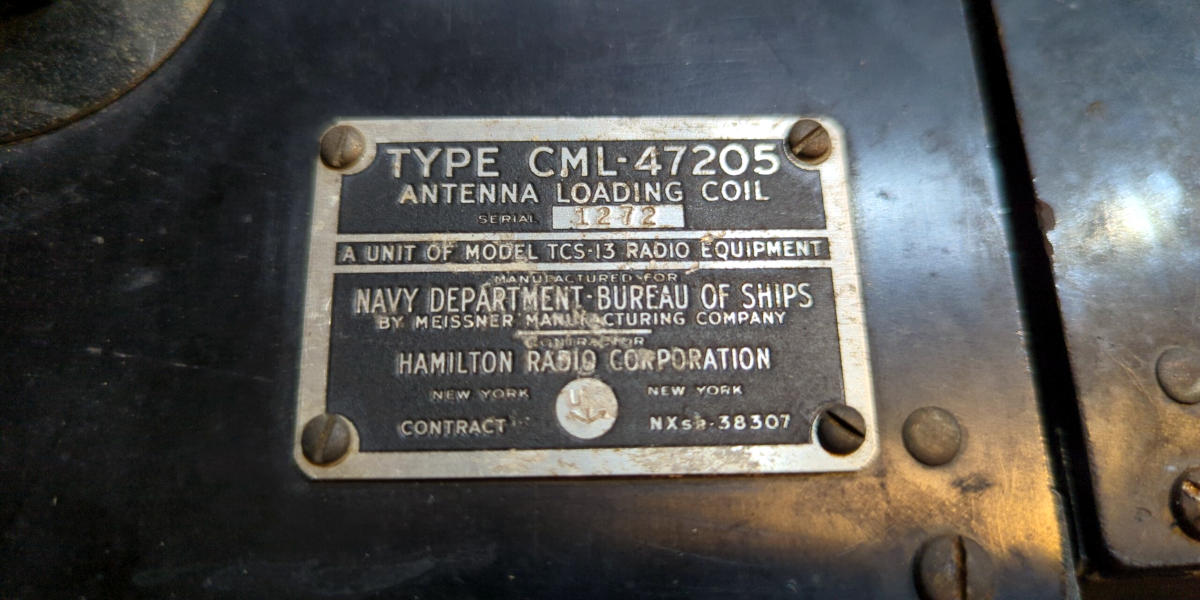
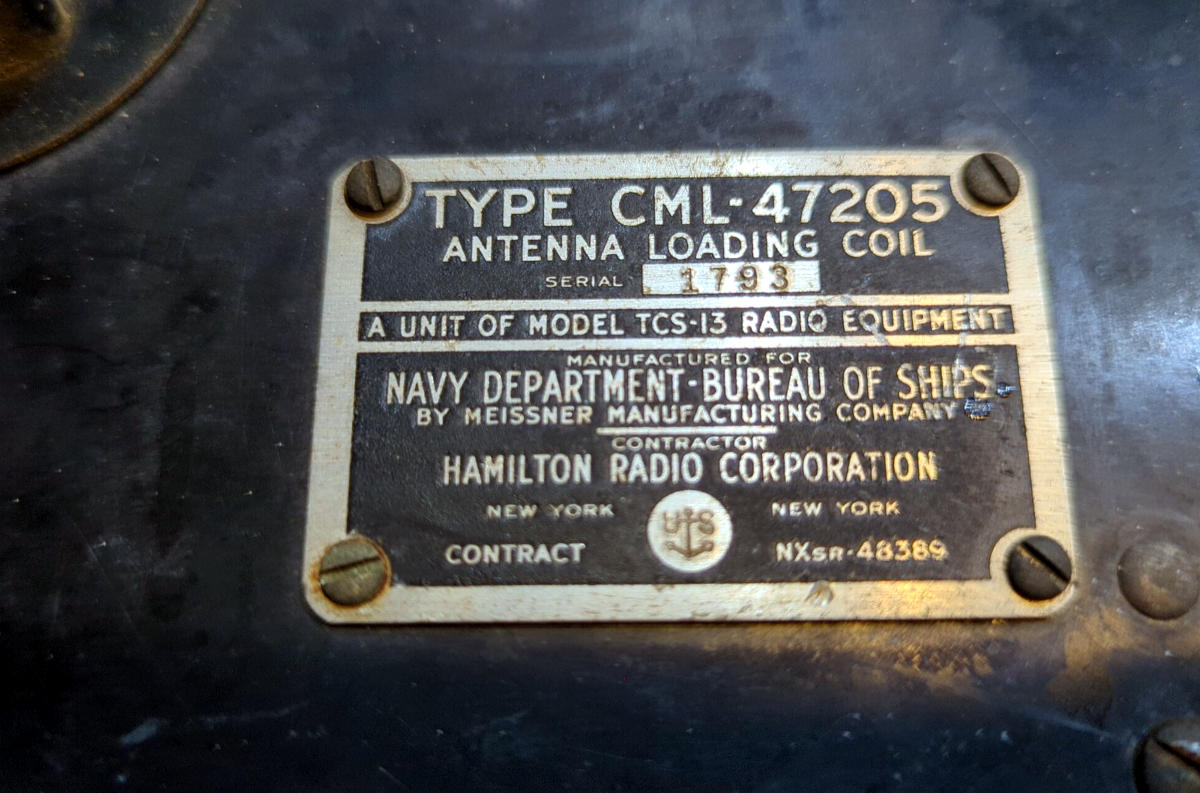
CML-47205 Antenna Loading Coil

While doing a bit of clean up in the garage, I came across the CML-47205 antenna loading coil units. They came as part of a couple of US Navy TCS-13 transmitter/receivers that ended up in my collection a few years ago.
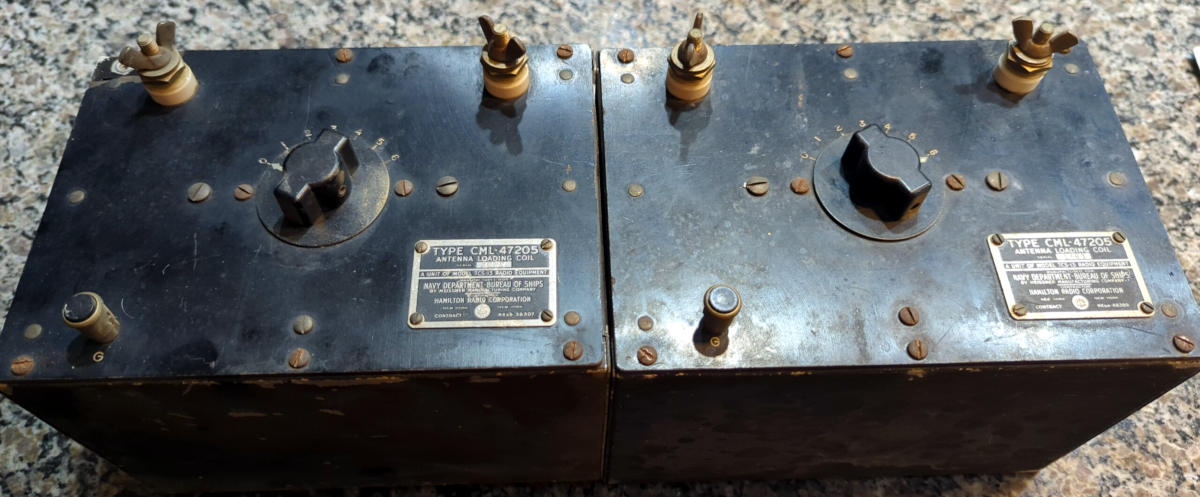
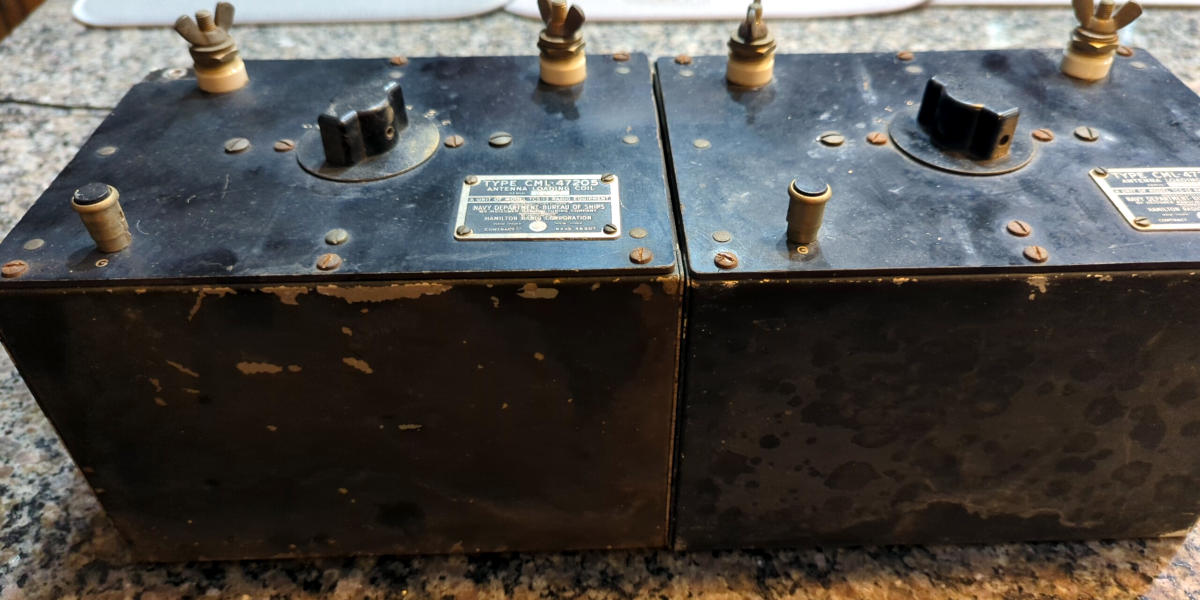
They’re simple black boxes, 6 x 8.5 x 5.75 inches with a 7 position dial switch numbered 0-6, 2 thumbscrew terminals and a ground terminal. The top cover plate appears to be a plastic/resin material (Bakelite or something similar I’m guessing) and the rest of the enclosure is metal. The corner of the top plate on one of the units was broken and the screw missing. Inside it’s pretty simple, a multiposition switch and a tapped inductor coil on a plastic form.
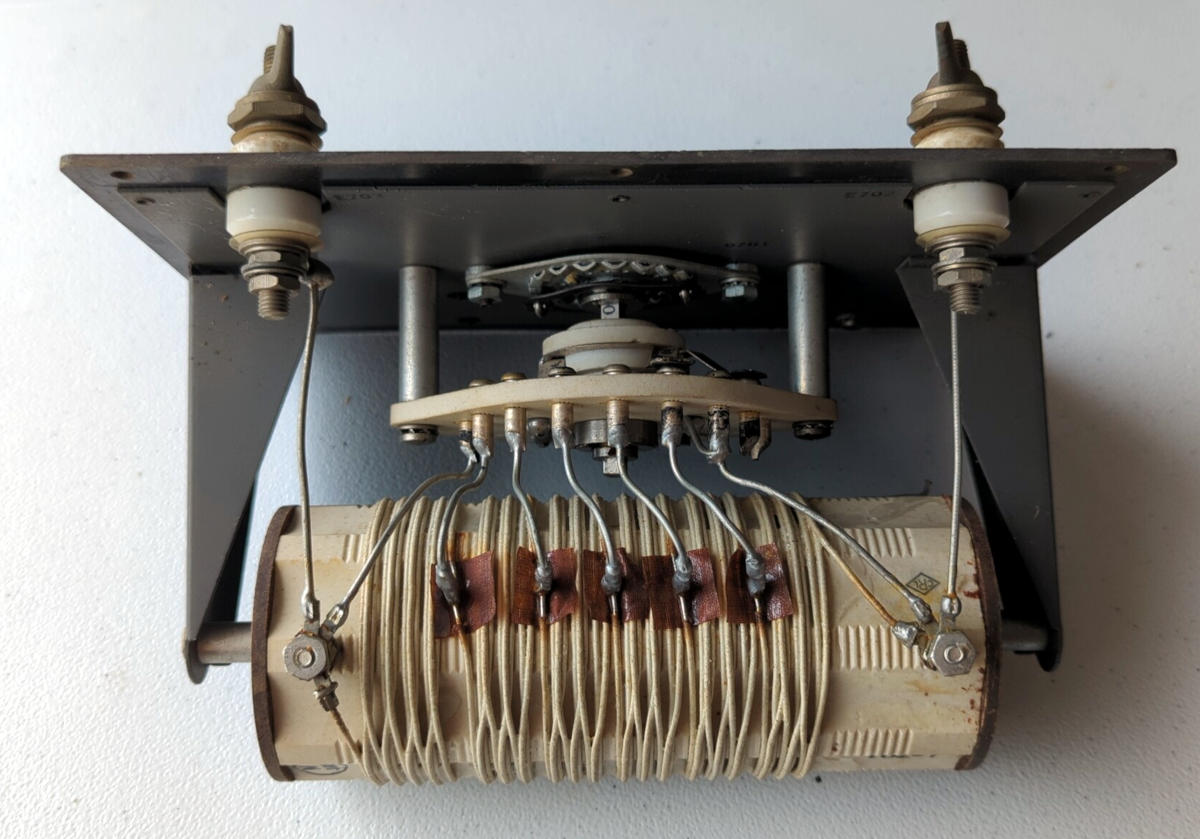
From the manual, it’s meant to be used with a 20 foot whip between 1.5 – 3 MHz. Dial setting 0 selects the highest inductance for the lower frequencies, while dial setting 6 selects the lowest inductance for the higher frequencies.
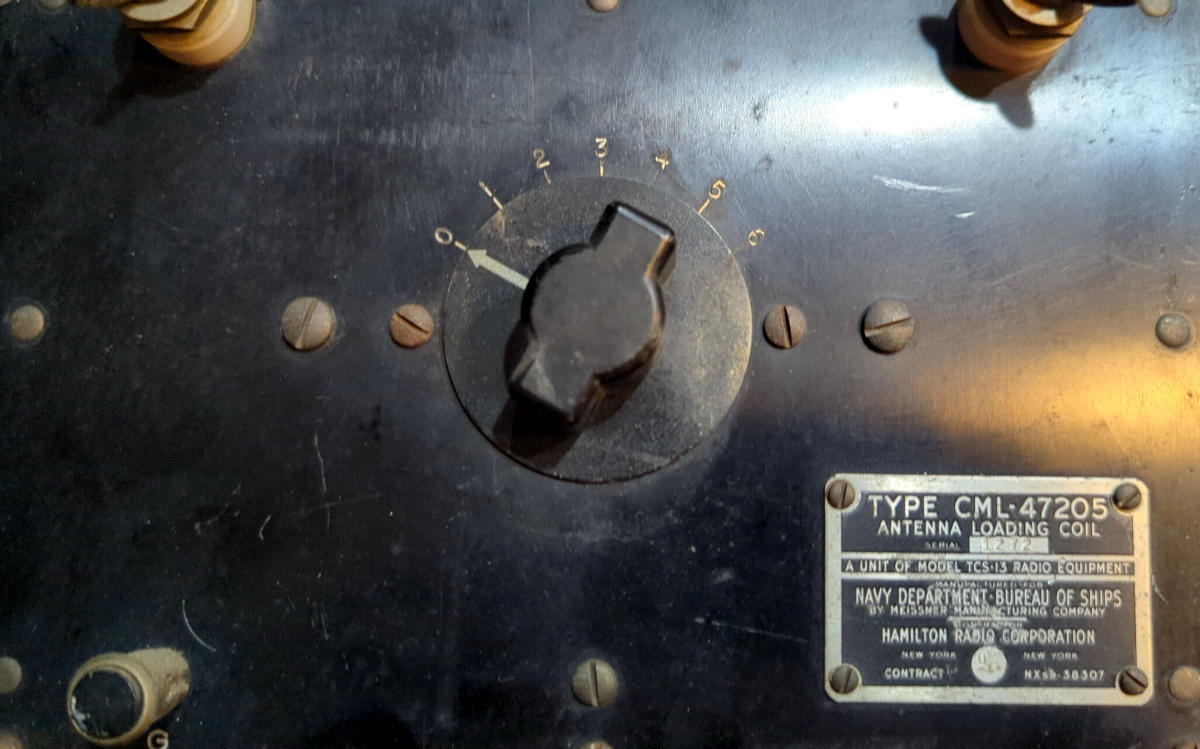
CML-47205 dial switch

Using my AADE LC meter connected across the two terminals, I measured the inductance for each position.

Dial settingInductance (μH)
SN 1272
Inductance (μH)
SN 1793
098.3297.76
176.4975.81
259.0858.57
341.7841.51
425.8325.53
512.9812.72
60.460.38

Might be interesting to see if I can incorporate these into a vertical antenna for Field Day.
Underground antennas

While researching the W8NYY call sign written in the 1937 ARRL Handbook I picked up, I came across a NOARS (Northern Ohio Amateur Radio Society) newsletter from March 2019 with a column by W8GWD answering a question about underground antennas. In it, he references an article from a March 1948 QST (a typo in the newsletter gives it as May 1948) by Paul Cornell/W8EFW who wrote about his investigations into rumours of buried antennas. W8EFW related a conversation with W8NYY who worked W8RJF, who was using an underground antenna

One day, while having lunch with W8NYY at Akron, Ohio, Lloyd told me that he had worked W8RJF in Cleveland, on 10, and that RJF mentioned that his antenna was buried in the ground.”

Underground Antennas: Are they fact or fiction? – Paul Cornell W8EFW March 1948 QST

W8EFW goes on to talk about meeting W8RJF to learn more about his underground antenna: a doublet fed through some garden hose and buried 4-5 feet underground.

An editor’s footnote in W8EFW’s article mentions a letter in the May 1925 QST where 5Rx/5XAY describes using a wire antenna buried one foot underground and operating on 80, 50, and 40m.

I’ve heard of antennas on the ground (such as a BOG/Beverage On Ground) but the idea of underground antennas is a new one to me. Apparently some have been used on the 2200 and 630m bands. Now I’m intrigued. I need to dig into this some more.

6m/10m attic dipole

Joining the 2m ground plane antenna in the attic now is a 6m/10m fan dipole.

There are too many rafters and roof supports above the ceiling to easily get a longer antenna into the attic, but a 10m dipole is short enough to get up there with some reasonable effort. I decided might as well make it a fan and add 6m to it as well.

Getting the antenna installed in the attic and connected up turned out to be a process that spanned a few weeks, but yesterday I finally got it connected up to the antenna analyzer (RigExpert Stick 230) and got everything trimmed up to about as good as it was going to get.

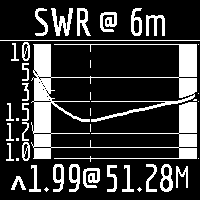
The SWR is under 3 for most of the 6m band dipping down to just above 2 around 51 MHz. For the 10m band, the SWR is under 2.6 across the band and dipping down to just above 2.2 at about 28.8 MHz.

The radio’s internal antenna tuner seems to handle the antenna pretty well. Now to see if I can make any contacts with it…

Antenna and filter books

Two new additions to the library arrived in the mail this week thanks to the 2018 ARRL auction.

In this year’s auction, I managed to score a copy of Antenna Theory: Analysis and Design 2nd ed by Constantine Balanis, and Rapid Practical Designs of Active Filters by DE Johnson and JL Hilburn.

Both books are in pretty good condition, especially the Filter book considering that it was published in 1975.  The Antenna Theory textbook still has the 3.5″ disk in the back unopened.

I was hoping to get at least one of the Vibroplex bugs that were also in the auction, but a flurry of last minute bidding drove the price higher than I wanted to pay for them.  Oh well.

Happy with the books I managed to get though.  They’ll be good additions to the library.

2m antenna monopod attachment

A while back, I made a monopod to use with my camera. Handy thing to  use when I don’t feel like lugging around a tripod. Also serves as a nice walking stick.

On one of my last visits to Radio Shack, I picked up two telescoping antennas thinking that I could use them as dipole elements.

Add one section of aluminum angle stock, a bulkhead BNC jack, a couple 1/2″ 4-40 screws and nuts and now I’ve got a telescoping 2m dipole antenna attachment for the monopod.

Monopod antenna attachment

It took me a while to figure out how I was going to insulate one of the telescoping elements from the angle stock. While I was studying the problem, a solution struck me: plastic wall anchor. Worked perfectly.

Tuning the antenna was a simple matter of adjusting the length of each telescoping antenna to get close to 1:1 across the 2m band.

Tuning the monopod antenna attachment

Looks pretty good. I’ll check it again outside over the weekend and try it out with the HT.

Monopod antenna attachment

If I hold it up in the air by the base of the pole, I can get the antenna about 2.5 m up in the air. I’m hoping I’ll be able to reach the two repeaters that are about 8 miles away a little better than I can with the HT antennas I already have.