To make better use of the CARS club room on the USS Yorktown, Jim/KK4REM has taken on the task of organizing monthly operating days open to any club members. Being on the Charleston Harbour and with an HF antenna at a pretty decent height over salt water, the ship is usually a pretty good place to operate from.
There are several purposes for the operating days:
Teach new hams proper operating procedures
Let people who might not normally use HF experience HF operations
Put the club equipment to use
I was able to make it to today’s operating day, and with the club’s laptops, the plan was to do some digital work as well. By the time I arrived at the club room, there were a few people already playing on the radio making some contacts on 20m. One of the contacts even included someone who served on the USS Yorktown back in the 50s.
Operating in the WA4USN club room on the USS Yorktown
After a few contacts, the Signalink was hooked up and a couple people were introduced to some of the digital modes. Did a little bit of PSK and some RTTY. I was busy with other things so I don’t know if any contacts were made.
While they were playing radio, I was showing my sound card interface to Rick/N8BKN and discussing the possibility of maybe making it a build project for the club. Bryce/K4LXF showed up a little later and from him I learned a little more about the repeaters that the club maintains.
I also got the opportunity to see the WA4USN repeater room., located a couple decks below the top of the Yorktown’s island. There’s not too much in there: the 2m repeater, a repeater controller and the WA4USN-5 APRS digipeater.
WA4USN APRS digipeater
WA4USN APRS digipeater
One of these days I might have to help maintain these repeaters.
I’ve been wanting something small and portable that I could carry around with me for doing Morse Code practice. The Heathkit HD-10 oscillator is fun to play with, but kind of big and chunky to haul around. The ARRL code oscillator is small and portable, but the buzzing sound gets kind of unpleasant to listen to after a while.
Then I found Jason’s/NT7S schematics for his code practice oscillator (CPO) in his blog and decided to build one. I gathered up the pieces and tried to assemble it on a breadboard a while ago but got distracted by other things and never quite finished.
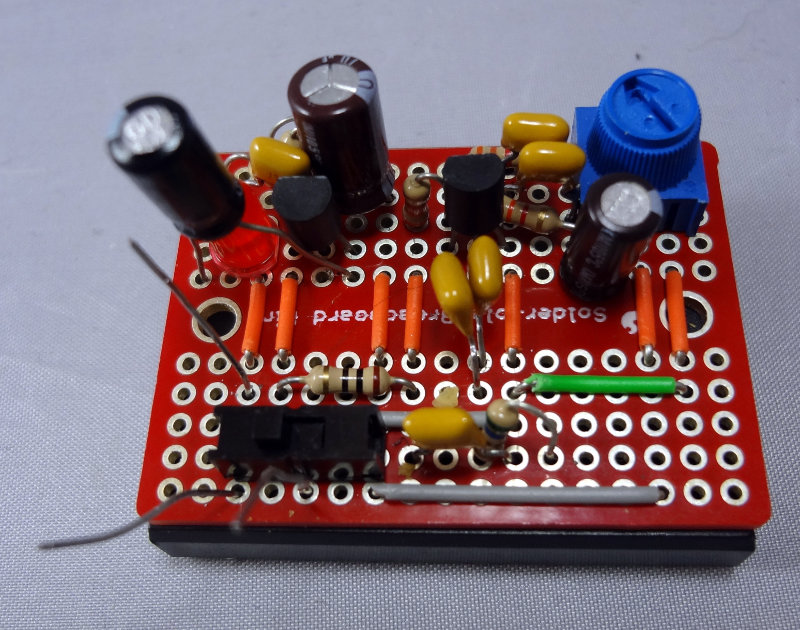
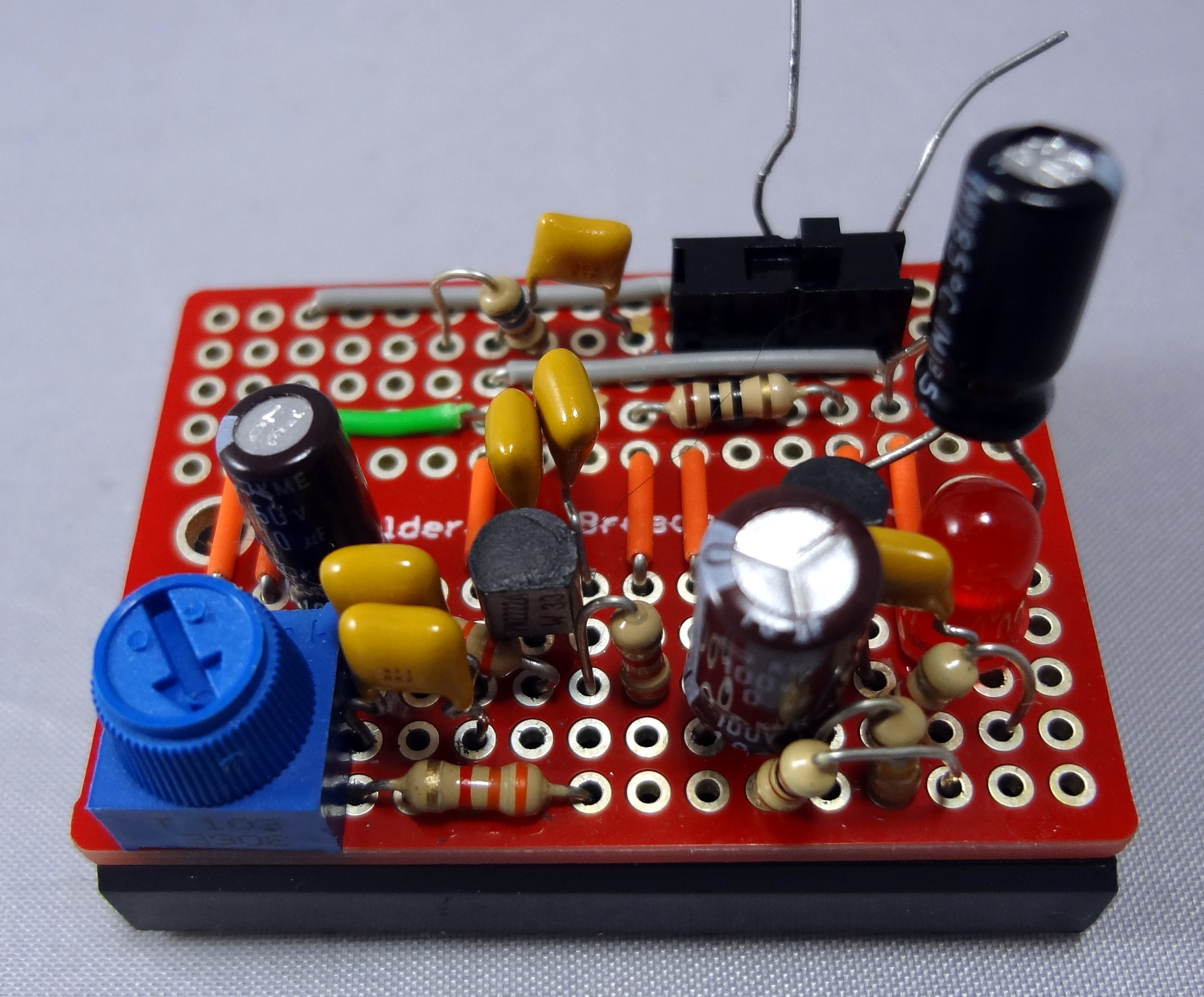
With the acquisition of some solderable mini-breadboards from SparkFun and the perma-protoboards from Adafruit, it was time to get back to the project. The Sparkfun mini breadboard fits perfectly on top of one of their modular mini breadboards so I put the solderable breadboard on top of the modular breadboard and started laying out the components. Then, once I’m done all I have to do is carefully lift the solderable breadboard off the modular breadboard and then solder away.
After spending some time staring at the schematic and the breadboard pondering how to lay things out, I remembered a suggestion from the kit building forum at the ARRL Centennial Convention. Build modularly and test as you go so that if something doesn’t work, it’s easier to isolate the problem area.
With this in mind, I started with the power section of the schematic and laid that out in one corner of the board. Add power, flip the switch, LED comes on. Perfect!
The CPO is small and simple enough so that the rest of the circuit pretty much falls into place after that. After a few hours of placing components, double checking placement and debugging, I finally managed to get it working.
NT7S Mini-CPO
NT7S Mini CPO
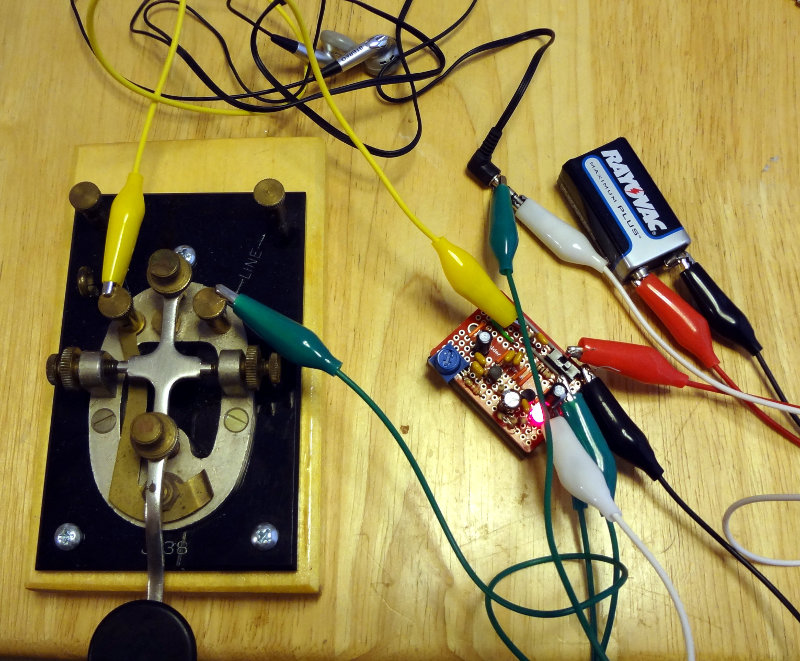
With a few wires, I connected my straight key and connected straight to the plug of some ear buds I had lying around. Tapping on the key yielded some pleasant sounding tones, and turning the pot changed the volume (and frequency a tiny bit).
NT7S Mini CPO connected to the straight key
Now all I need to do is solder everything into place, add some jacks and stick it into an enclosure.
A nice, easy build and I was able to do it all with parts I had on hand.
At the ARRL Centennial convention, Connie pointed me toward the Radio Amateurs of Canada (RAC) table after she spent some time talking to them. I spoke to George/VE3YV about RAC and amateur radio in Canada, and in the process learned that because I’m still a Canadian citizen and not a US citizen, reciprocity doesn’t apply to me so I can’t play radio while I’m in Canada.
We talked about me getting a Canadian amateur radio certificate (it’s not a license anymore) while I’m back home in Edmonton in September. Certification exams are given by Designated Examiners (DEs) and if I can find one while I’m home, I should be able to take the test.
Canadian amateur radio certificates come in two flavours: Basic and Advanced. The Basic test is 100 questions with a pass mark of 70%. If you get over 80%, you’re awarded a Basic with Honours (or Basic Plus) certificate. The Advanced test is 50 questions with a pass mark of 70% and gives you the full privileges.
Like the VEC program in the US, Industry Canada publishes the question pool for both tests so preparing for the tests would be a matter of collecting the appropriate materials and reviewing them and the questions.
I’ve had a very quick look at a few of the questions in both pools, and it seems to me the level of knowledge required for the Basic certificate is about the same or maybe a little bit more than the General class license in the US, while getting an Advanced certificate requires a little more electrical and radio theory than the Amateur Extra class.
I’ve got a couple of months to study and get ready. Piece of cake.
We made the trippilgrimmage to the ARRL 2014 Centennial Convention this past weekend (July 17-20, 2014) in Hartford, CT. Had a fantastic time and we’re so glad we went. We had planned to go a while back, then decided not to go, but then in May (practically last minute) decided that it was an event we needed to go to.
We flew out Wednesday so we could be there for the whole three days. After we got off the plane, we made our way to the bus stop to catch the bus into Hartford. On the way to the bus stop, we met a ham from Germany, DJ5JH and had a nice conversation while we waited for the bus to show up. We ended up being joined by a few more hams by the time the bus arrived.
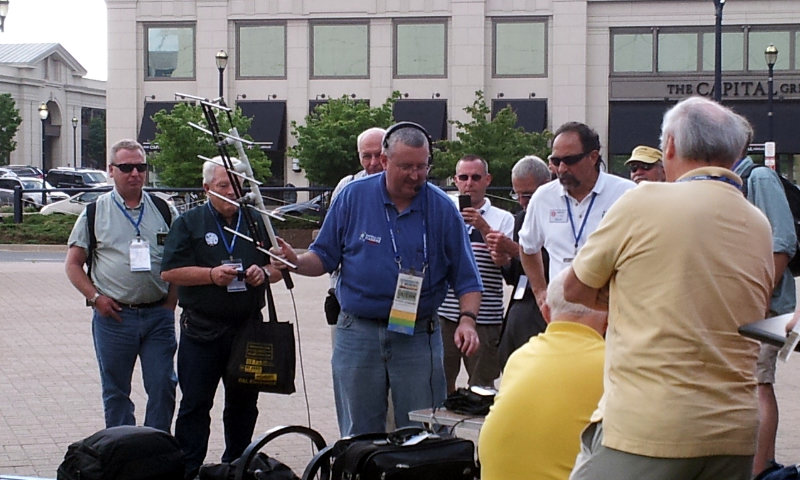
The first day (Thursday) consisted of a number of training tracks. I spent my time in the Intro to Amateur Radio Satellites and learned a lot about the history of amateur radio satellites, how they get into space and how to make contacts through them. Thoroughly enjoyed it and I think it will be another aspect of amateur radio that I will eventually explore. The track ended with an outdoor demonstration of making satellite QSOs through the OA-7 satellite using a handheld antenna and two Yaesu 817s.
Making satellite QSOs
The Thursday training tracks included a lunch with a very inspiring and motivating talk given by ARRL First Vice-President Rick Roderick/K5UR. He told some funny stories about his amateur radio adventures and challenged everyone there to leave an amateur radio legacy and promote amateur radio to youths.
Friday and Saturday was spent in a variety of forums and wandering around the exhibit hall. There was a pretty decent amount of activity in the exhibit hall. Although the flea market area was pretty small, there were a few things I think I might have come away with if luggage space wasn’t an issue. I ended up buying a copy of The Best of Idea Exchange from the QRP ARCI table and ARRL’s Hand’s On Radio Experiments.
There were a lot of interesting non-vendor related tables that were worth lingering at in the exhibit hall. The W1TP Telegraph Museum had a lot of neat old telegraph equipment and a very cool collection of Enigma machines. There was the fully restored 1964 Collin’s Communications Van and the working phonograph at the Vintage Radio and Communications Museum of Connecticut table.
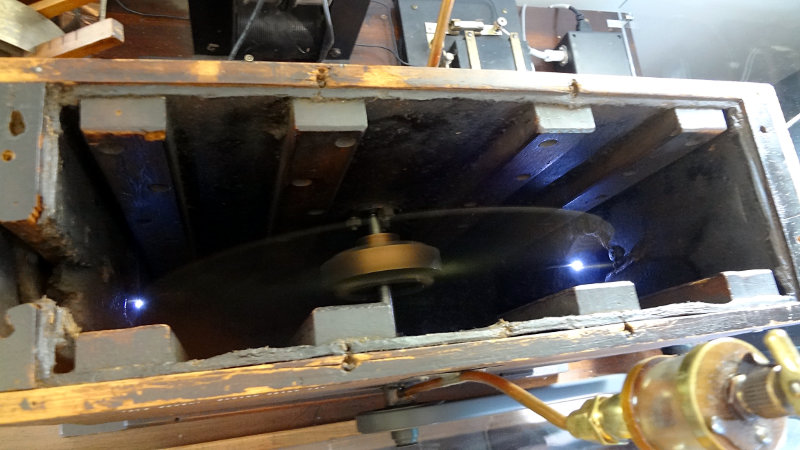
One of the highlights of Friday was the trip out to ARRL headquarters and W1AW. There’s a pretty impressive collection of vintage and antique radio gear, and the ARRL Testing Lab was a pretty neat area, especially for a geeky type like me. They even fired up Old Betsy, Hiram Maxim’s spark gap transmitter, for a little bit. It’s a loud beast.
“Old Betsy”, W1AW’s spark gap generator
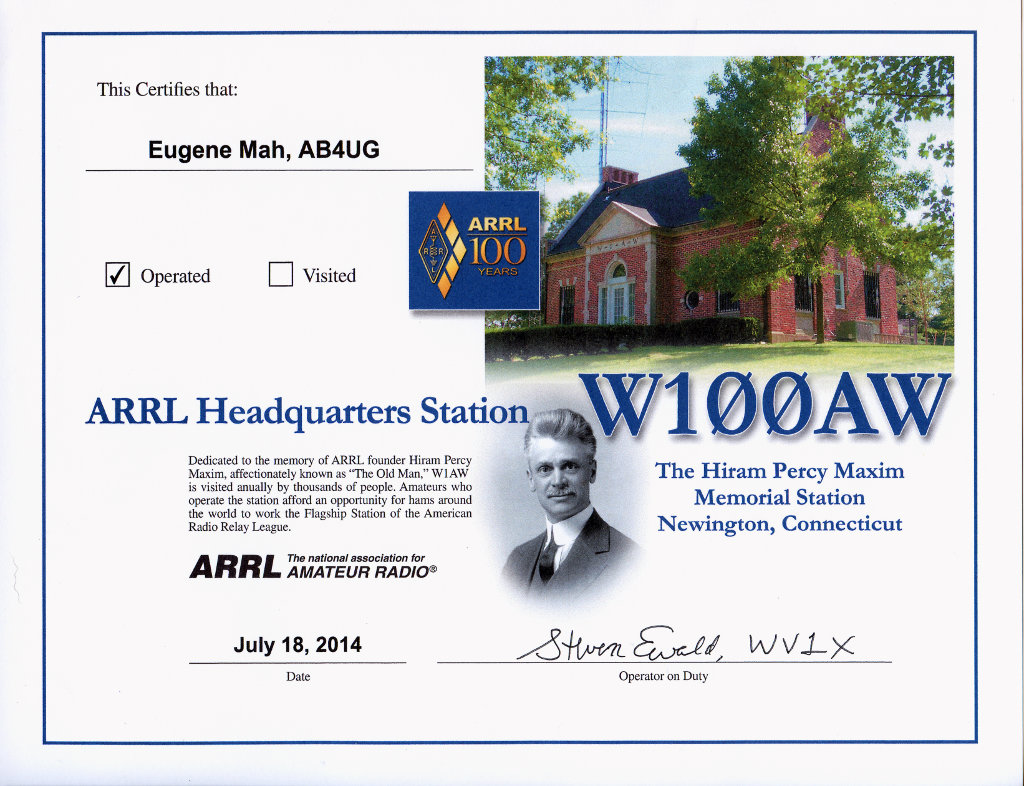
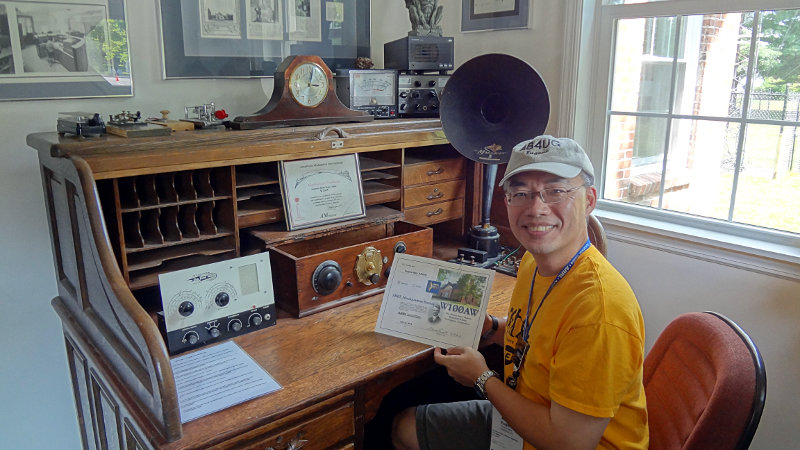
For the convention, operating slots for W1AW were being scheduled in 15 minute windows. I was able to get a slot operating in Studio 1 and operated as W100AW on 20m. Managed to get two contacts in, which I was pleased with. It was pretty cool being able to operate there.
At HPM’s desk
Saturday ended up being a pretty low key day. Went to one forum on antenna modeling and spent some time sitting and people watching, and wandering the exhibit hall some more. Had a Twitter/Reddit meetup in the afternoon where I got to make some eyeball QSOs with a few hams. Always nice to be able to put a face to the online persona.
Sunday was our travel day home, and we ended up being joined on the flight to PHL by DJ5JH. Not only was he the first ham we met in Hartford, he was also the last ham we saw when we left.