Back Yard Field Day Guidance Changes

W4BXC has done ARRL Field Day in the back yard for a few years now. While I was trying to figure out what class we’d be operating at a while back, I came across this in the ARRL Field Day FAQ. The 2023 (and earlier) Field Day Packet the question/answer says:

Q: We don’t have an area club, but we do have a small group of area hams (generally two or three of us get together for operating events). I have a large-deep property, and we will be setting up in my back yard. What Class would we be? Class A, Class B or ?

A: Convenient access across one’s back yard to their home station facilities is not in keeping with the spirit of Class A or Class B portable operations. Such convenient backyard operations on property of home stations remain either Class D (commercial power) or Class E (emergency power), even if home antenna structures are not used. If the station will be a “good hike” away from a home station (eg. at the rear of a several acre lot, or perhaps operating from a farmers field down the road) – clearly away from home conveniences (away from home utilities, or home restrooms/bedrooms, or even eating facilities/refrigerator/kitchen) – then Class A (3 or more persons portable) or Class B (1 or 2 person portable) is appropriate.

ARRL Field Day Packet 2023

Because of this, W4BXC has been operating as Class E for the last few Field Days.

While preparing for Field Day 2026, I went to look at the rules and FAQ again. The 2026 edition isn’t out yet but the 2025 edition is still available. Much to my surprise, I found the response to the same question had changed. Now, the answer reads:

A: Class B stations, like Class A are designated as portable stations – the difference between Class A and B is the number of participants. Class B stations are limited to 1 or 2 participants, which includes anyone assisting in setup/breakdown, as well as actually operating. If you’re setting up at your property and you are not using your normal station, or using any facilities installed for permanent station use (including any antennas that you normally use), then you’d qualify as Class B. Other provisions are the same as Class A except it is not eligible for a GOTA station. If you’re operating at your normal station location using permanent station facilities, then you’d be a Class D or E home station.

ARRL Field Day Packet 2025

I don’t have the 2024 packet so I don’t know if the answer changed last year or before that.

I feel like this new answer is a little more ambiguous than the previous one, depending on how you interpret “using any facilities installed for permanent station use”. If you interpret that to mean just things related to the shack and radio operation (antenna, feedline, base station, shack, etc) then it’s a more relaxed version than the previous answer. If, on the other hand, you take a much broader interpretation to include things like “home conveniences” mentioned in the previous answer, then the answer remains the same only worded differently.

I’m going to go with the former interpretation where “facilities” refers only to things related to the shack and radio operation (antenna, feedline, radio, power, etc). For our past Field Day activities, we’ve never used anything permanently set up for the regular shack, and we plan to keep doing that this year. I think this means that W4BXC can operate as Class A this year.

Field Day 2025

W4BXC was on the air for another backyard Field Day, this time from Stan’s (WA4BXC) back yard in Ooltewah, TN. This year we were operating as 1E TN. Present for Field day were Stan WA4BXC, Connie NR4CB, and Eugene AB4UG. We had several friends show up, including one of the neighbours, Steve KQ4SMI, who got on the air for his very first Field Day. In between operating stints, there were breaks around the fire pit for roasting hot dogs, marshmallows, and making s’mores.

Solar panel used to charge the batteries used for Field Day.  The panel consists of four smaller panels and is propped up on a hand truck to face the sun.
Solar panel used to charge the batteries, with manual sun-tracking.

The antenna was put up between two large trees with the help of Stan’s “air cannon”. It did a pretty good job getting the ends of the antenna up to a decent height, although overall antenna height was a bit limited due to the presence of other wire antennas. The center of the dipole ended up about 20 feet in the air. Good enough that the radio’s tuner didn’t complain on the 40m, 20m, 10m, and 6m bands.

Dipole antenna suspended in the air
Air gun constructed from white PVC pipe used to hang the antenna in the air

Band conditions were decent. Not the greatest, but not awful. Propagation seemed to disappear in the late afternoon/early evening, but then improved later into the evening. Bands on Sunday morning were pretty good, but then faded a few hours before noon and didn’t improve much the rest of the day.

Operations were interrupted briefly for a couple hours when thunderstorms rolled in late Saturday afternoon. Thankfully the really heavy rain moved around us instead of over us and we only got rained on a little bit. Wouldn’t be Field Day without thunderstorms.

For logging, not1mm was used instead of the usual N1MM+ that has been used previously. It does a pretty good job at replicating most of the features that makes N1MM+ a good program for contest logging, but is Python based and runs well under Linux.

Field Day wrapped up with 123 contacts, 21 more than last year. Contacts were made mostly on 40m and 20m, with a handful on 10m. The radio was powered entirely on battery power (a 100 Ah LiFePO) that had been charged with solar power, which qualified us for the natural power bonus (100 points). The battery had no problems keeping the radio going at 100 W, and I don’t think we made much of a dent in the battery’s charged capacity.

Field Day 2025

BandQSOs
781
1436
286
Total123
Field Day QSO summary

Field Day 2024

Another back yard Field Day putting the club call (W4BXC) on the air is in the bag. Like last year, we were 1E SC.

As is typical for the end of June around here, the weather was hot and humid, but partly cloudy skies kept things at least tolerable. Fans came in handy as well. Fortunately there were no thunderstorms as often happens this time of year.

Had a bunch of friends over and introduced some of them to amateur radio. Most of the afternoon was spent casually operating in between hanging out, chatting and answering a few questions about amateur radio.

This year, the antenna for the 2m radio (just used to monitor simplex an repeater activity) was a janky mag mount attached to the side panel of a PC case, and perched on top of my ladder. Seemed to work well enough. There wasn’t much in the way of repeater activity to listen to though. We did manage to convince a couple of our friends and one of their kids to get on the radio (VHF simplex) from across the yard.

The batteries did pretty well again this year keeping the radios running and putting out 100 W.

Band conditions seemed pretty decent, and most of the contacts were on 20m and 40m. Oddly enough, I heard very little on 10m.

Wrapped up the Field Day weekend with 102 contacts across the 20m and 40m bands. A few contacts short of last year’s total, but I’m satisfied with the result. 200 bonus points brings our score to 404 for this year.

Contest: FD
 Band     QSOs     Pts  Pt/Q
     7      37      37   1.0
    14      65      65   1.0
 Total     102     102   1.0
Score: 204
1 Mult = 1.0 Q's

Field Day 2023

This year, W4BXC was on the air for Field Day as a 1E SC station after we noticed one of the Field Day FAQs said

Convenient access across one’s backyard to their home station facilities is not in keeping with the spirit of Class A or Class B portable operations. Such convenient backyard operations on property of home stations remain either Class D (commercial power) or Class E (emergency power), even if home antenna structures are not used.

ARRL Field Day 2023 packet

Like last year, we had the radio running on three deep cycle batteries connected in series, and they had no problems providing enough power to keep the radio transmitting at 100W the entire time we were operating.

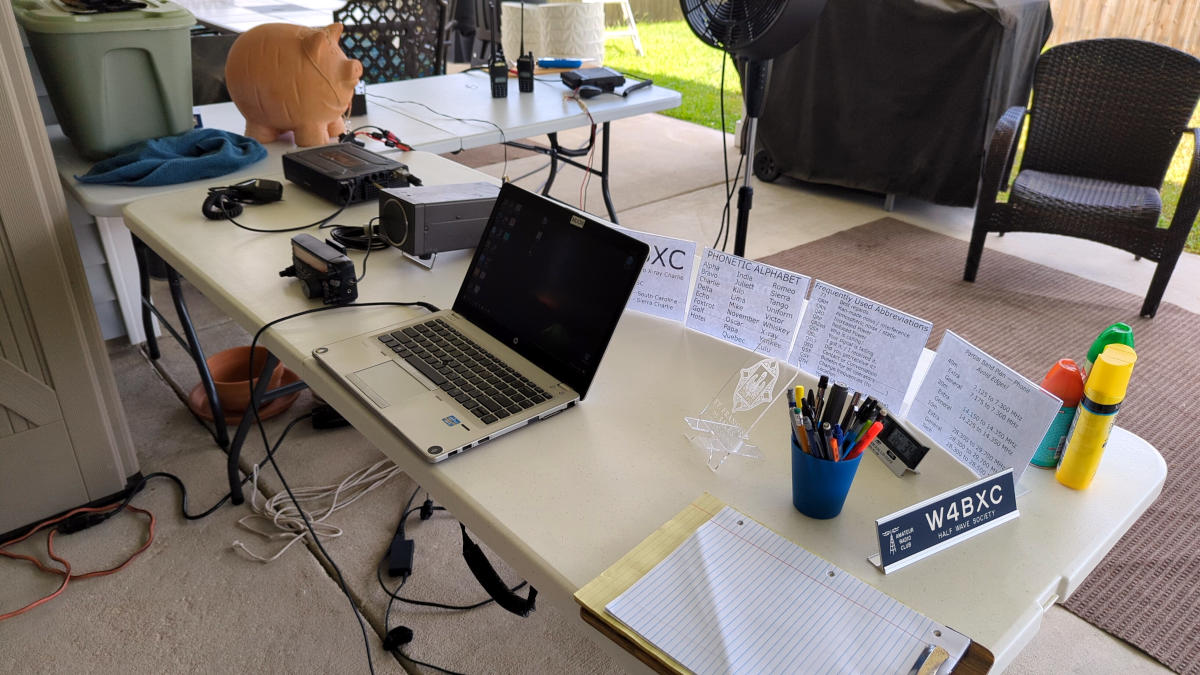
Radios and laptop set up for ARRL Field Day 2023
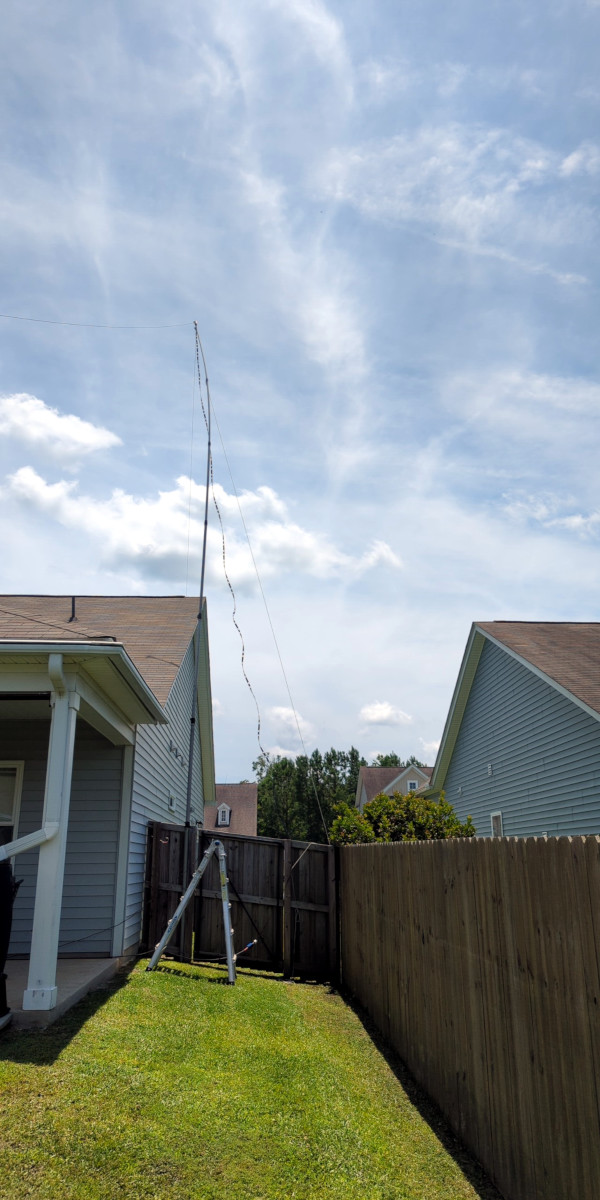
Antenna set up for ARRL Field Day 2023

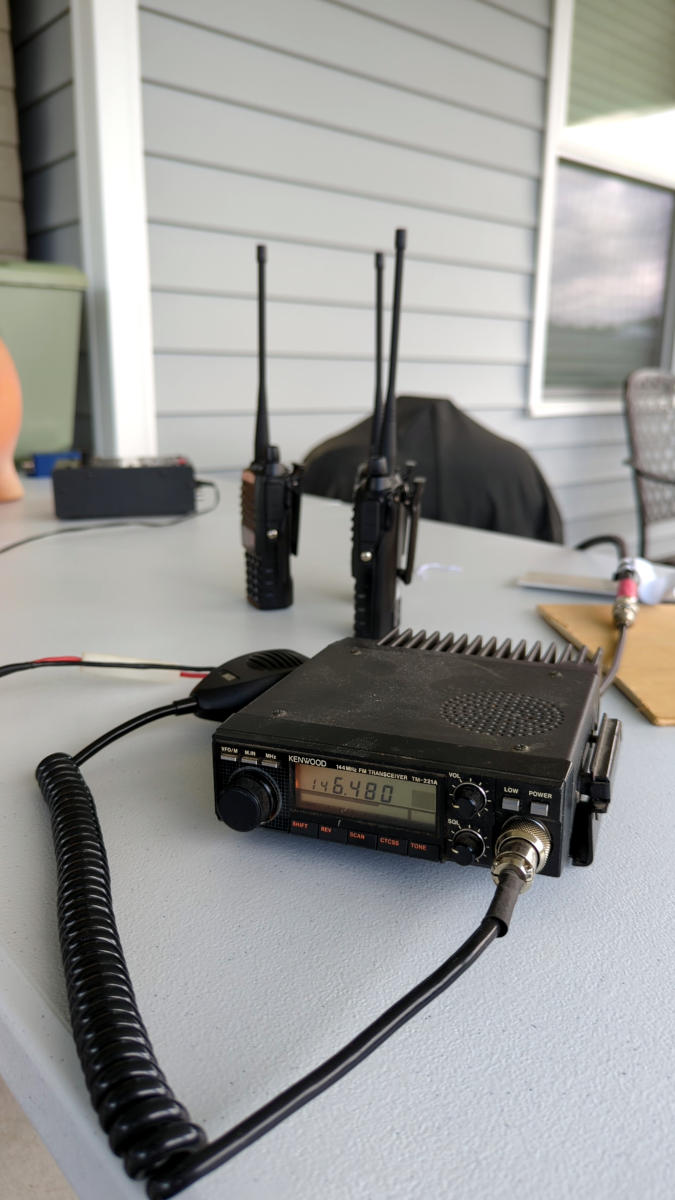
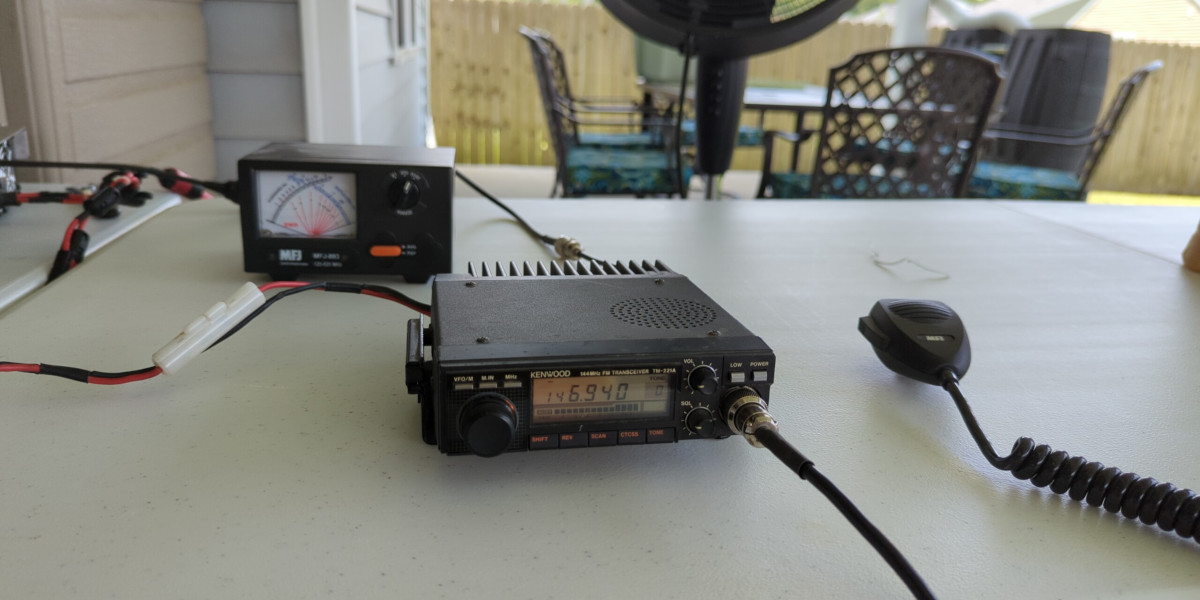
I also set up a recently acquired Kenwood TM-221A 2m radio to monitor repeater activity.

Kenwood TM-221A mobile radio set up for ARRL Field Day 2023

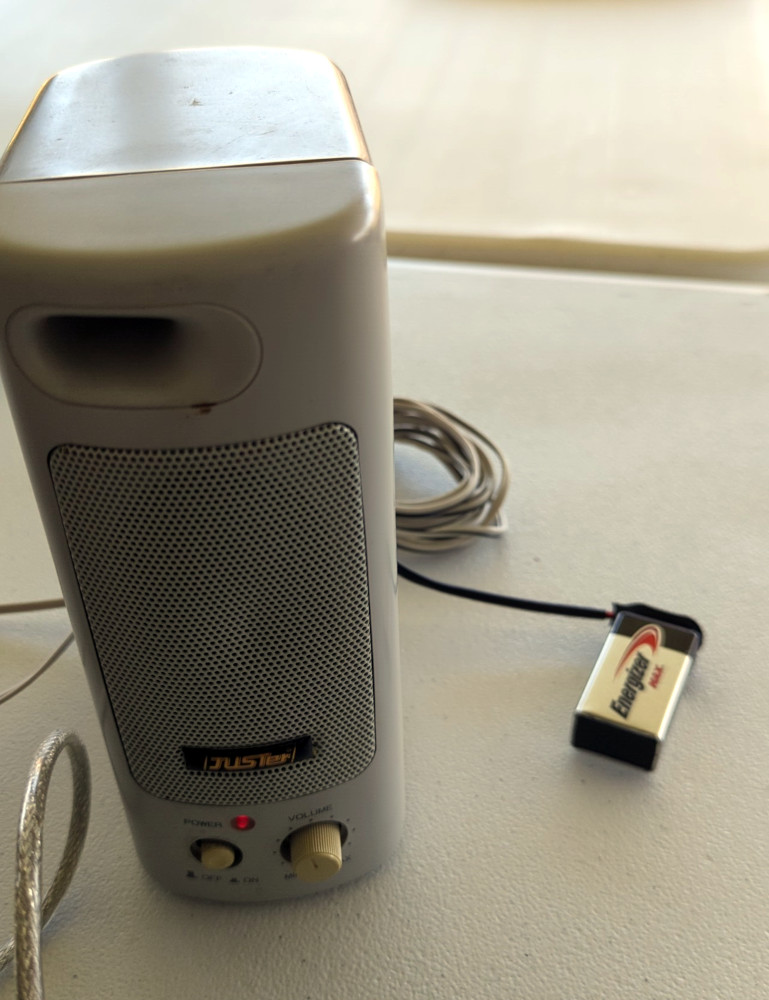
I noticed this computer speaker used a 9V DC power supply, so I decided to power it with a 9V battery and connect it to the radio. Worked out pretty nicely. Note: if you notice that the noise characteristics from the speaker have changed, it probably means the battery is going dead and needs to be replaced. Took me a while to figure out what was going on.

Computer speaker connected to a 9V battery for power

The bands were crowded but pretty mushy during the day on Saturday. Lots of noise, quiet stations fading in and out, and only a few really loud ones. Things started getting better into the late afternoon and early evening and stations out on the west coast in the LAX and SDG (San Diego) sections started coming in pretty well. We waited for the ARRL Field Day bulletin and copied it down before calling it a night.

The next morning I got back on the air and worked a bunch more stations. A nice mix of sections across the country and into Canada. All the contacts we made ended up being on the 20m and 40m bands. Made a few forays up to 10m, but heard absolutely nothing there which kind of surprised me.

Ended up with a total of 106 contacts in the log for a total of 212 QSO points. 350 bonus points brought our total score up to 562 points. Final score might end up being a bit higher, because this year we’ve got some of W4BXC’s non-local members participating as well.

Field Day 2022

The Half-Wave Society, W4BXC, was on the air once again from our back yard for Field Day this year. We were joined this year by newly inducted members Mark W8ZRB and Scarlett KO4ELA and their respective families.

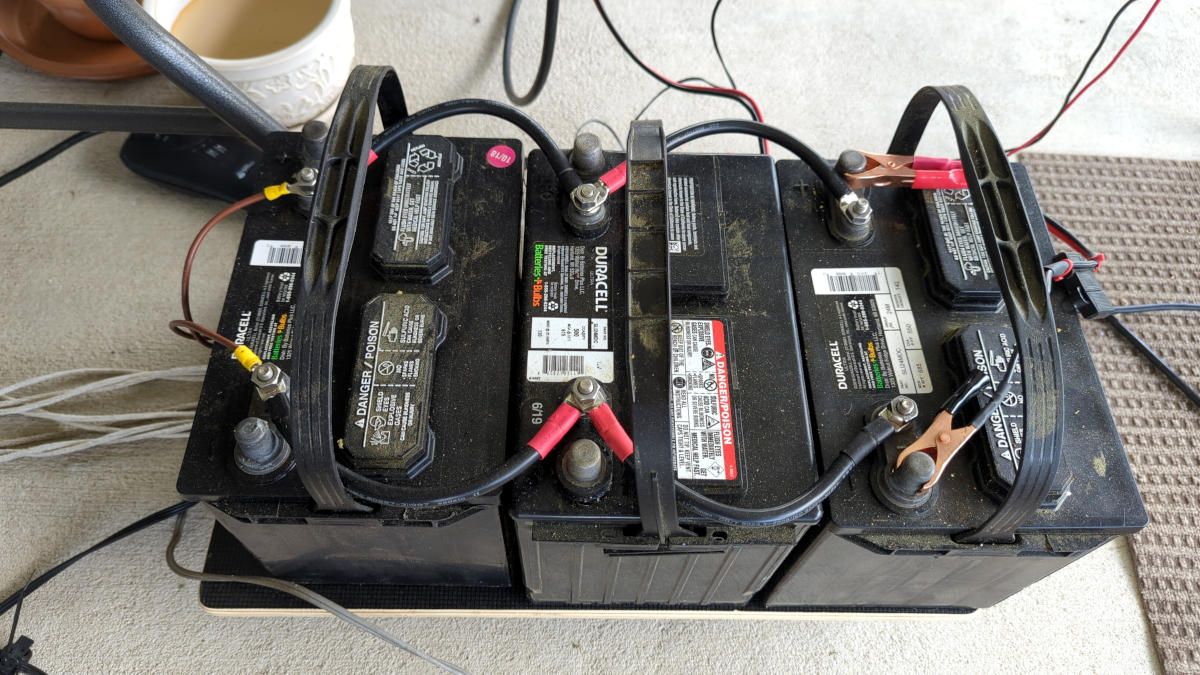
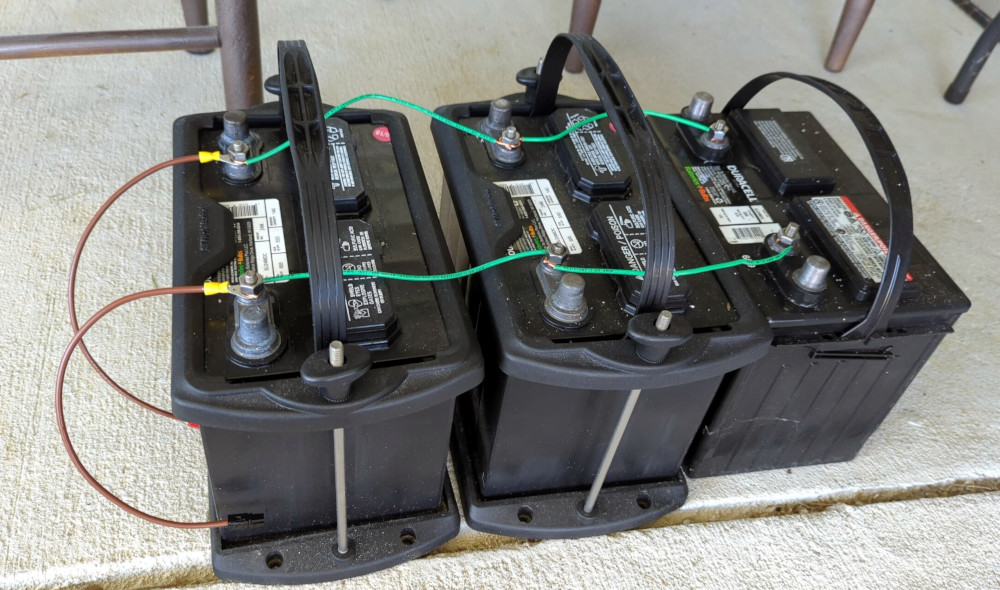
Three deep-cycle AGM batteries provided an ample amount of power for the HF and 2m radios this year and had no problems keeping the HF radio going at 100 W. I’ve run the HF radio on one of these batteries before, but this is the first time I’ve had all three connected together to provide power.

Three deep cycle AGM batteries connected together in parallel
Battery power for Field Day 2022

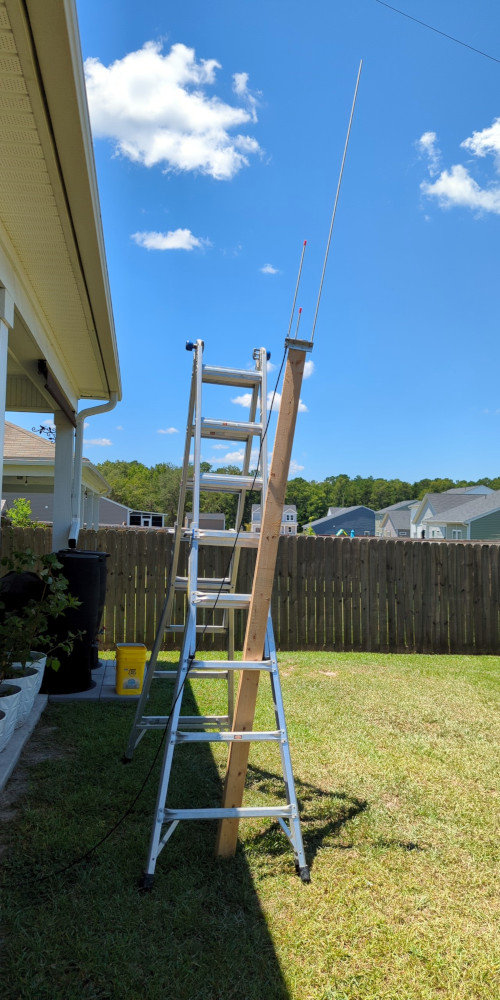
An Arrow 2m/70cm J-pole was set up for the 2m radio. Wasn’t hearing much on the repeaters, but we did use the 2m radio to put some of the kids on the air over simplex with a handheld.

Radios and laptop on a table with three batteries supplying power

The CW key collection and Heathkit code practice oscillator I set out on the dining room table proved to be popular items with the crowd that wasn’t outside with me playing radio.

Amateur radio items on display for Field Day 2022

We managed a total of 67 QSOs this year on the 10m, 20m, and 40m bands. Propagation on 10m was pretty much non-existent. I wasn’t hearing any stations at all on Saturday, and just a lone station out of Missouri Sunday morning.

This year we’ve decided to make Ham the Terracotta Pig the official mascot for the W4BXC Half Wave Society. I think he makes for a very majestic looking mascot.

W4BXC Mascot Ham the Terracotta Pig