Dit dah-dah

I’ve managed to successfully build my first electronics project since the light box I built back in Industrial Arts class in Junior High school.

After seeing one of these Morse code key kits at the Dragon*Con ham radio table I helped out with, I decided they were pretty cool and that I should try to build one. Just the thing I need to help me learn and practice Morse Code/CW.

It’s a pretty simple kit without a whole lot of components. Everything’s all made up, so it’s just a matter of sticking the right electrical bits into the proper holes and soldering them into place. It’s been a long time since I soldered anything. I practiced a little bit on some old laptop power supply parts I had laying around, then went to work on the kit. The inexpensive soldering iron I picked up at Radio Shack a while ago did an ok job, although it seemed like it took a while to heat things up enough to melt the solder. Fortunately the solder stayed in the places I wanted it to be and I didn’t make any short circuits.
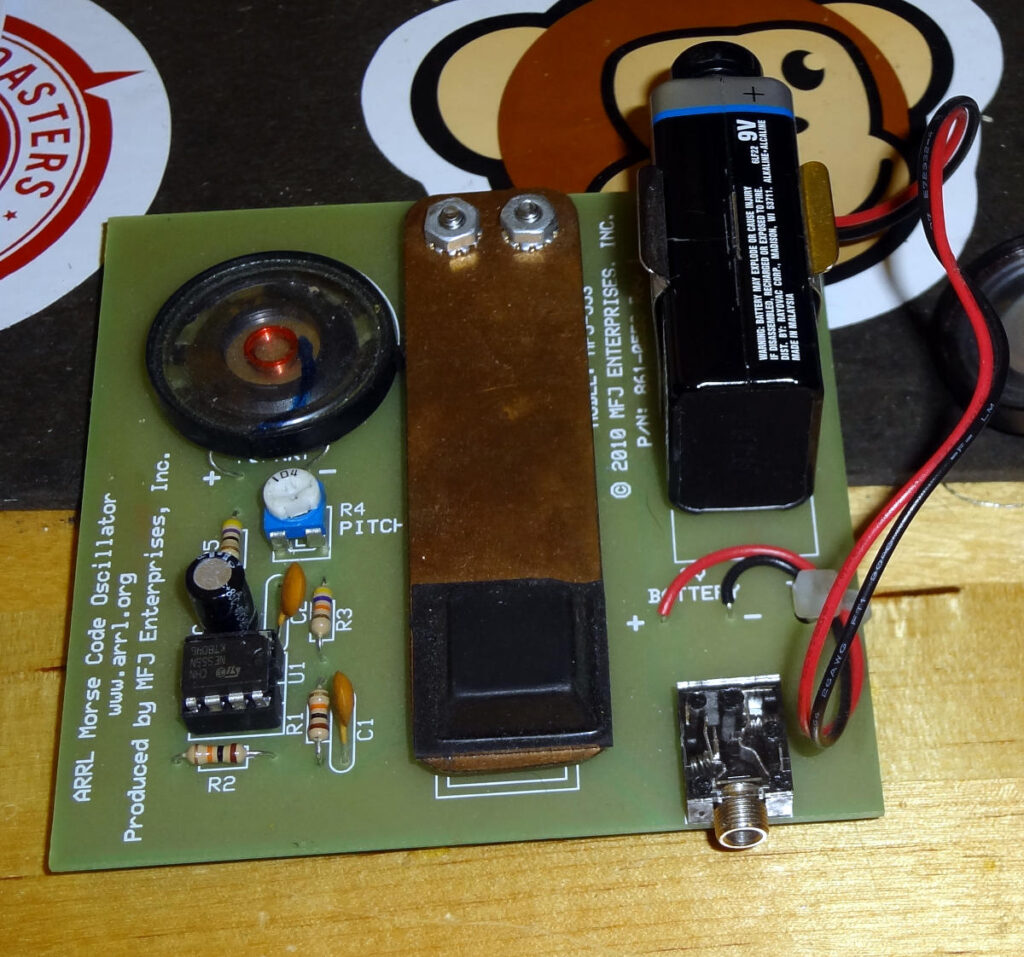
ARRL Morse code oscillator

I also put my Cold Soldering iron to work on a few parts, which actually worked reasonably well while the tip lasted. Because of the gap it uses in the soldering tips, the cold soldering iron works fine for large things, but is ineffective for small soldering jobs.

Total time was maybe 2-3 hours. If you’re good at soldering, it’s something that could easily be assembled in an hour or less. My soldering isn’t great, but everything works. Kind of tempted to get another one…maybe lay it all out on a breadboard and experiment with modifying it.

Accessorizing the radio

My radio has its first accessories: a speaker/mic (MH-74A7A) and the GPS module.

The first thing that struck me about both the speaker/mic and the GPS unit was how small they were. Quite a bit smaller than what I expected from a hand mic (something big and chunky). The MH-74A7A is the size of my palm and at first seems like it would be too small to hold or use comfortably. Turns out to be not so bad though, and the lighter weight (compared to holding the radio) will probably mean less fatigue when playing radio. I think the cord weighs more than the microphone itself. There’s a single PTT button on the side and that’s it, so using it is pretty simple.

Sound quality is pretty much the same as what I get out of the radio speaker, although perhaps not quite as loud. No complaints there. The nice thing is that I can clip it closer to my ear for easier listening, rather than walking around holding a radio up to my head. Stick the radio in the side pouch of my backpack, clip the speaker/mic to the shoulder strap and i can walk around listening to the weather radio or for any radio activity. Much easier than walking around holding the radio up to my ear or in front of me.

The GPS module is even smaller than the speaker/mic (about half the size) and plugs right into the top of the speaker/mic and secured by a screw. So far it seems to work pretty well and gives the radio GPS capabilities and makes the radio’s APRS feature useful. It’s small and light enough that it doesn’t make the speaker/mic top-heavy when it’s attached and secured into place.

Overall, the combination is nicer and much easier to use than I expected it would be at first glance. Used it a few times now to play radio and so far the most awkward part is getting tangled up in the cable. I think I’m going to enjoy using the speaker/mic with my radio.

Thoughts on HamCamp

Just a few thoughts as I continue to ruminate on the idea.

The idea of the HamCamp is to start with a mini-camp within BarCampCHS. Sessions and presentations should be short (maybe 15-20 minutes) so that a few can be fit into each BarCampCHS block. They can be introductory for new hams/wannabes or cover more advanced topics

  • Good radio conduct
  • Antenna anatomy
  • Assembling a ham shack
  • Licensing/regulations
  • Radio bands
  • Digital radio modes
  • CW (Morse code)
  • Echolink/Winlink/IRLP
  • Contesting

There can be outdoor sessions and demonstrations which obviously won’t be constrained by BarCampCHS scheduling.

  • Radio demonstrations
  • Antenna building

HamCamp

With BarCamp Charleston getting closer, the idea popped into my head about doing something similar with ham radio, a Charleston HamCamp.

Ham radio has a strong tradition of mentoring, or “Elmering” in ham-speak. Having an event like HamCamp seems like it would be a great way to foster more Elmer-like activities. It’s an idea that’s been kicking around in my head for all of a couple hours now, so not entirely fully formed yet.

It would follow the BarCamp concept, so people could come and provide talks, demonstrations, tutorials and share other ham radio related information and ideas. There will be some space to set up portable radios, something outdoor to show off things like antennas and get some radio activity going.

Maybe it can start off as a mini-camp at BarCamp Charleston…